🏗️ The DAMA Data Management Framework: A Blueprint for Sanity
How to turn chaos into clarity with a practical, proven framework.
🐘 The Blind Men and the Data Elephant
You’ve probably heard the story of the blind men and the elephant. One touches the trunk and thinks it’s a snake. Another touches the leg and thinks it’s a tree.
Data is exactly like that.
- The Software Engineer thinks data is JSON APIs.
- The Analyst thinks data is a Tableau Dashboard.
- The Security Officer thinks data is a Risk.
- The CEO thinks data is “The New Oil.”
They are all right, but they are all missing the big picture. This disconnect causes chaos: duplication, security gaps, and “truth” that changes depending on who you ask.
☸️ Enter the DAMA Wheel
The DAMA-DMBOK (Data Management Body of Knowledge) provides a unified view. It organizes data management into 11 disciplines, arranged in a wheel.
Why a wheel? Because Data Governance sits at the hub, holding everything together.
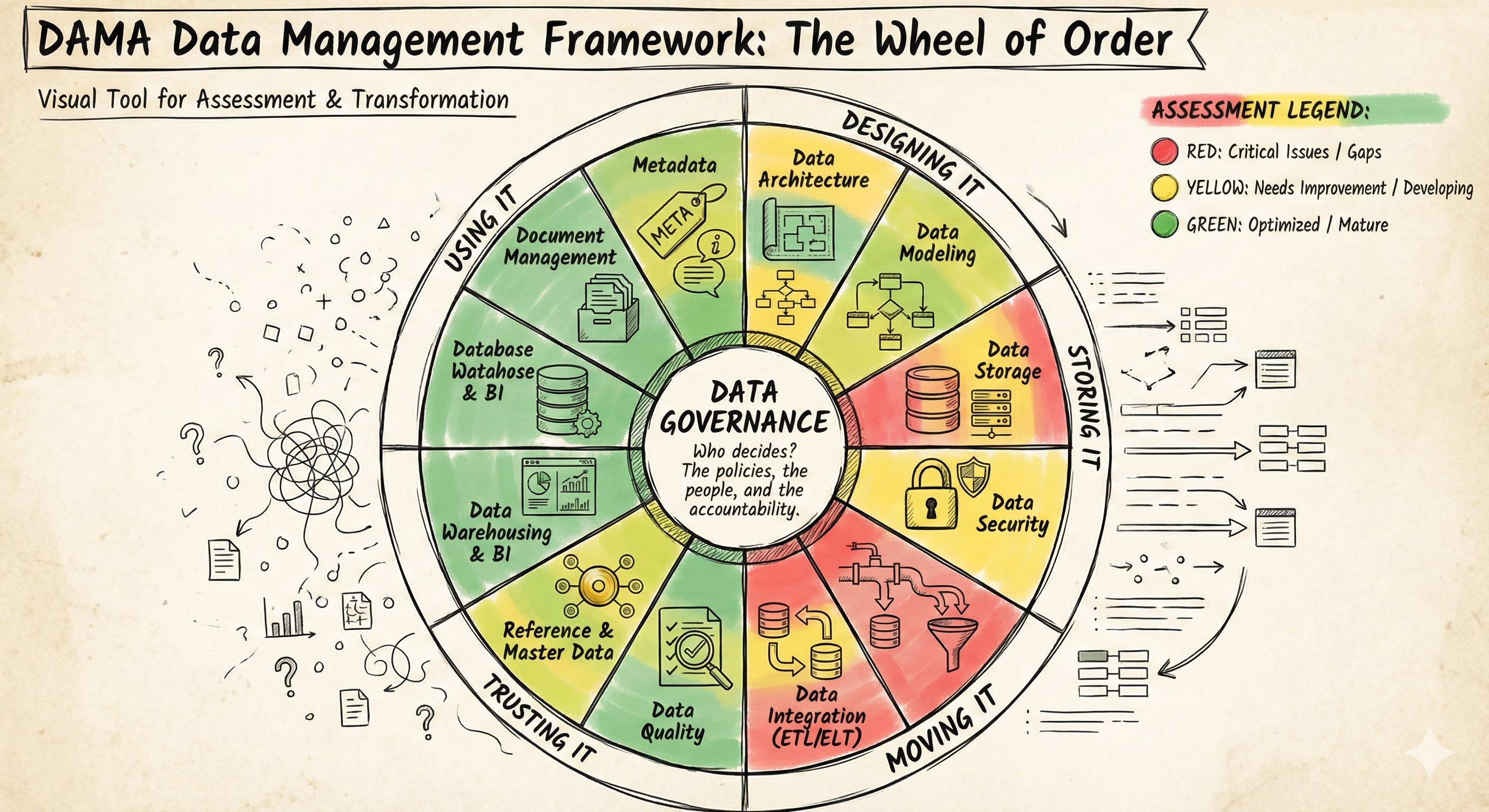
1. The Hub: Data Governance
This is the center. It answers: “Who decides?” Without governance, the wheel falls apart. It’s the policies, the people, and the accountability.
2. The Spokes (The 10 Disciplines)
I won’t list all definitions, but here is how they group together practically:
- Designing It: Data Architecture, Data Modeling.
- Storing It: Data Storage, Data Security.
- Moving It: Data Integration (ETL/ELT).
- Trusting It: Data Quality, Reference & Master Data.
- Using It: Data Warehousing & BI, Document Management, Metadata.
🔍 Real-World Example: The “Missing Owner”
I once worked with a client who had excellent technology. They had Snowflake, Airflow, Looker—the works. But their “Customer” table was a mess.
- Marketing updated it via CSV uploads.
- Sales updated it via CRM.
- Support updated it via tickets.
Who “owned” the definition of a Customer? No one. We used the DAMA framework to point out the missing wedge: Master Data Management. We didn’t buy a new tool. We just assigned a “Data Steward” (a person!) to own the definition. Problem solved.
🔄 How to Use DAMA (Without Falling Asleep)
The DMBOK is 600 pages long. Do not try to implement it all at once.
The “Crawl, Walk, Run” Strategy:
- Assess: Look at the wheel. Color code each slice Red, Yellow, or Green based on your current state.
- Prioritize: You can’t fix everything. Pick three slices to work on this quarter. (Hint: Data Quality and Governance are usually good starts).
- Clarify Ownership: For each slice you pick, name one person who is accountable.
✅ Key Takeaways
- Governance is the Hub: If you don’t have governance, you don’t have management; you have accidental success.
- Don’t Boil the Ocean: Use the wheel as a map, not a checklist.
- Break Silos: Use the visual to show the Software Engineer why the Analyst needs Metadata.
💬 Final Thoughts
The DAMA framework isn’t just academic theory for passing exams. It’s a common language.
When you can point to the Wheel and say, “We are strong here (Architecture), but weak here (Quality),” you stop arguing about opinions and start solving problems.
It’s a blueprint for sanity in a chaotic data world.