⚡ A Short Preview Before We Begin
Before I publish the first deep‑dive post, I want to pause for a moment.
Not to explain what Generative AI is — there’s enough content on that already.
But to explain why this series needs to exist at all.
Because if you’re a Data Engineer, Data Solution Architect, or Analytics Architect, you’ve probably felt this quietly:
“Something fundamental is changing… but I can’t clearly articulate what.”
This preview post is for that feeling.
🧩 The Problem No One Is Clearly Talking About
Most Gen‑AI content today falls into one of three buckets:
- 🚀 Tool‑first hype (new models, new APIs, new demos)
- 📚 Academic explanations (LLMs, transformers, embeddings)
- 🎯 Executive POVs (AI strategy, AI vision, AI maturity)
What’s missing?
👉 The architectural middle ground.
The place where real systems are designed. The place where data either enables intelligence — or silently breaks it.
That’s where Data Solution Architects live.
And right now, that role is being reshaped without a clear playbook.
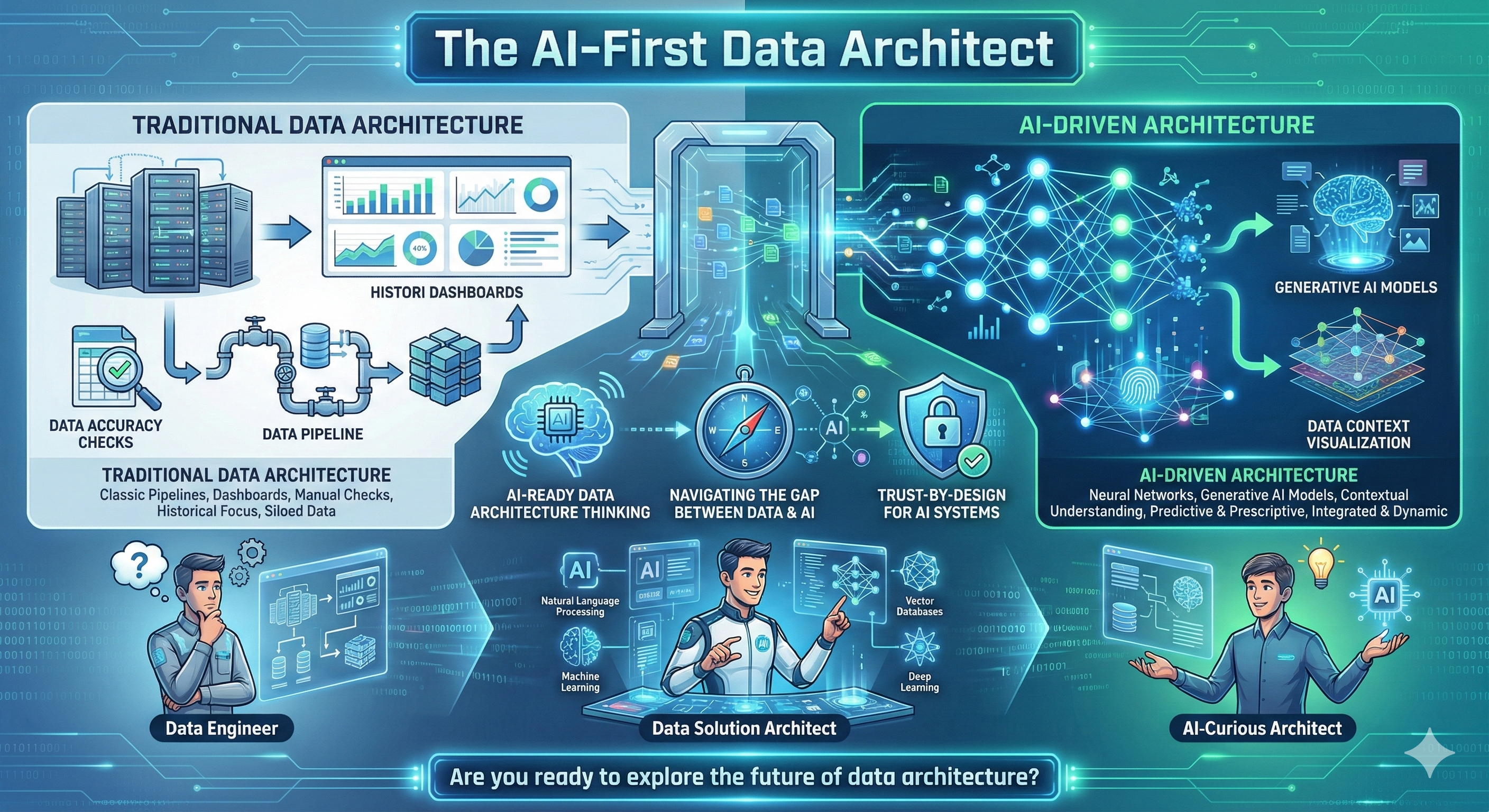
🏗️ Why Traditional Data Thinking Is No Longer Enough
For years, we were successful by answering questions like:
- Is the data accurate?
- Is the pipeline stable?
- Are dashboards performant?
But Gen AI introduces new failure modes:
- Models hallucinate despite “correct” data
- Context is missing even when pipelines succeed
- Latency kills usefulness
- Governance breaks in subtle, invisible ways
Suddenly, being technically correct is no longer sufficient.
Architecture now needs to answer:
Can this system reason responsibly, consistently, and in real time?
🎯 Who This Series Is For (And Who It Isn’t)
This series is for you if you are:
- 🧠 A Data Engineer aspiring to think architecturally
- 🏗️ A Data Solution Architect feeling the Gen‑AI pressure
- 🤖 An AI‑curious architect trying to find your place
This series is not:
- A crash course on LLM internals
- A vendor comparison blog
- A hype‑driven AI success story
It’s a thinking framework, not a certification guide.
🧭 The Gap This Series Intends to Fill
Here’s the exact gap:
| What Exists Today | What’s Missing |
|---|---|
| AI model discussions | AI-ready data architecture thinking |
| Data engineering best practices | Data-as-context design |
| Governance checklists | Trust-by-design for AI systems |
| Career advice | Role clarity in the Gen-AI stack |
This series lives between data and AI, where most failures — and successes — actually happen.
📅 What Will Come Next (High‑Level View)
Over the next 10+ weeks, we’ll explore:
- Why traditional data architecture feels insufficient
- How roles blur between DSA, AI Architect, and EA
- What AI‑ready data really looks like
- Why vector databases change architectural patterns
- How governance, ethics, and trust become architectural responsibilities
- How to evolve your career without restarting it
Each post will:
- Focus on one architectural shift
- Use real‑world reasoning (not toy examples)
- Leave you with something actionable
📌 Why I’m Publishing a Preview First
Because this series is a conversation, not a broadcast.
Before diving deep, I want to validate:
- Does this problem resonate with you?
- Are you facing similar architectural confusion?
- Do you want depth over speed?
Your feedback will shape:
- The depth of technical detail
- The balance between career vs architecture
- The real‑world examples I use
✍️ What Happens After This Preview
If this resonates:
➡️ Week 1 launches next:
💀 Is Traditional Data Architecture Dying in the Gen‑AI Era?
That’s where we’ll start challenging assumptions — gently, but honestly.
Until then, consider this a checkpoint.
If you’ve felt the shift but lacked the language to describe it — you’re not alone.
— A Data Solution Architect learning to design for AI, not just data.